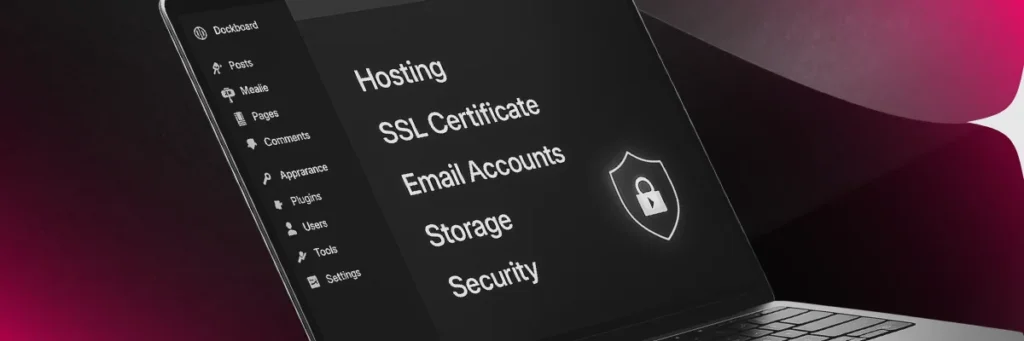
If you have ever paid a hosting invoice and thought "I am not entirely sure what I am paying for," consider this your guide to website hosting explained – plainly and honestly. Most business owners use a website for years without really understanding what keeps it online, who is responsible for what, and why certain costs come around every month or every year.

There is no reason to feel embarrassed about that. After all, you did not build your website to become a hosting expert. Having a basic understanding of how website hosting works does help you make better decisions, ask better questions, and avoid a few common and costly misunderstandings.

So let us start from the beginning.
Quick Summary
A domain name is your address on the internet. Website hosting is where your website files actually live. Email hosting is a separate service that can be included with WordPress hosting, but not necessarily with drag and drop platforms such as Shopify or Wix. Managed hosting means someone actively looks after your website as well as the server. Not all hosting is equal – look for uptime guarantees, included backups, SSL certificates, and local support.
What Is a Domain Name & Why Does It Matter for Your Business?
Your domain name is your address on the internet. For example, yourbusiness.co.za. It is what people type into their browser to find you, and it is what appears in your email address.

You register your domain name through a company called a registrar (wel known registrar companies like CloudFlare, Godaddy, Afrihost, etc) and you usually need to renew it every year or two. You do not own a domain name outright in the same way you own a piece of furniture. You lease the right to use it. If you stop renewing it, the domain becomes available for someone else to register.

This is an important point worth taking seriously. If your domain registration lapses, even for a short period, your website goes offline and your email stops working. In some cases, domain squatters pick up expired domains and then demand a significant sum to hand them back. Keeping track of your renewal dates is one of the simplest and most important things you can do to protect your digital presence.

The easiest way to think about a domain name: it is your address. It tells people where to find you. But it is not the building itself.
What Is Website Hosting?
Website hosting is the service of storing your website's files on a permanently connected server so that visitors can access your site at any time from anywhere in the world.

Your website is made up of files. Pages, images, code, videos, and all the other content that makes up what people see when they visit your site. All of those files need to live somewhere.

That somewhere is a server. A server is essentially a very powerful computer that is permanently switched on, permanently connected to the internet, and designed specifically to store and deliver website files to anyone who requests them.

Website hosting is the service of renting space on that server. When someone types your domain name into their browser, the internet looks up where your files are stored, connects to that server, and delivers your website to their screen. This all happens within seconds.

So if a domain name is your address, then hosting is the actual building at that address. The space where everything lives.
Why Do You Pay For It Every Month?
This is the question most people have but do not always ask. Hosting feels intangible in a way that a printed flyer or a once-off design job does not. But the cost is very real and very justified.

Running a server is not free or passive. Consider what your hosting provider is actually maintaining on your behalf:
- Why Server Costs Are an Ongoing Expense
The hardware, the electricity, the physical space in a secure data centre, and the constant connectivity all carry ongoing costs. These do not stop. - Ongoing Security: What Your Host Does Behind the Scenes
Good hosting providers run security software, actively monitor for threats, apply server-level patches, and maintain firewalls. They treat this as continuous work, not a once-off setup. - Backups take storage and management
If something goes wrong with your website, you want to be able to restore it from a recent backup. Your hosting provider takes ongoing responsibility for storing those backups securely and verifying that the restore process actually works. - Support teams have to be available
When something goes wrong at an inconvenient hour, someone needs to be there. That costs money too. - SSL certificates keep your site secure
The padlock symbol that appears next to your website address in a browser indicates that the connection is encrypted. Google now treats this as a basic requirement for any website, and your host needs to keep it maintained.
When you pay for hosting, you are paying for all of this, every month, reliably. A good hosting provider is quietly doing a lot of work in the background that you never have to think about.
Email Hosting: Why It’s Not Included on Every Platform
Here is where a lot of confusion and frustration comes in, particularly for businesses who have built their websites on platforms like Shopify, Wix, or Squarespace. Choosing the right email hosting for business use is just as important as choosing the right website platform.

Most of these hosted website builders do not include email hosting.
| Platform | Email Hosting Included | Extra Cost Required |
| WordPress (self-hosted) | Depends on your hosting provider | Depends on your hosting provider |
| Shopify | No | Google Workspace or Microsoft 365 |
| Wix | No | Google Workspace or Microsoft 365 |
| Squarespace | No | Google Workspace or Microsoft 365 |
Your website is hosted on their platform. But your professional email address, the yourname@yourbusiness.co.za that you want to put on your business card and sign off invoices with, is a completely separate service. On those platforms, you need to pay for it separately, usually through another hosting provider, Google Workspace or Microsoft 365, which adds another monthly or annual cost on top of your website subscription.
With a self-hosted WordPress website on a proper hosting plan, your package typically includes email hosting. Your website and your professional inbox are part of the same package, managed in one place, with one provider.
This matters practically and professionally. A business email address at your own domain tells clients immediately that you are established. It looks right on proposals, quotes, and correspondence. Sending business emails from a generic Gmail or Outlook address when you have your own website domain looks inconsistent, and some clients genuinely notice.
If you are comparing website options and this has not come up in the conversation, it is worth asking directly: does email hosting come with this package?
What Is Managed WordPress Hosting & Do You Need It?
You may have come across this term and wondered what it adds beyond standard hosting.

Standard hosting means the server is maintained, but your website is your responsibility. The host keeps the lights on, so to speak. What happens on your site, updates, security, performance, is up to you.

Managed hosting means someone is actively looking after your website as well as the server it lives on. This typically includes monitoring, regular updates, security scanning, and support when something goes wrong. For businesses running WordPress, managed WordPress hosting is often the most practical and well-supported option available. It is a more hands-on service, and for most businesses, it is worth the additional cost given what is at stake.
Shared Hosting vs Dedicated Resources
If you have ever seen these terms and been unsure what they mean, here is a plain explanation.
- Shared hosting
Means your website shares a server with other websites. The server divides its resources – processing power, memory, and bandwidth – across all the sites it hosts. This is perfectly suitable for most small to medium businesses, and it keeps costs down. Quality shared hosting from a reputable provider performs well and is entirely appropriate for the majority of South African business websites. - VPS or dedicated hosting
Means your website gets its own allocated resources, either on a virtual partition of a server or an entire server to itself. This is more expensive but offers better performance and stability for high-traffic websites or complex applications. Most small businesses do not need this, and being sold a more expensive plan than you need does not benefit you.
What To Look For In A Hosting Provider
Not all hosting is created equal. A few things worth checking before you commit:
- Uptime guarantee
A reputable host will advertise 99.9% uptime or better. This means your site should be online and accessible almost all of the time. - Backups
Are they included, how often are they taken, and how easy is it to restore from one? This is important. - SSL certificate
This should be included at no extra cost. - Email hosting
Ideally this should be part of the package rather than a separate purchase. - Local support
For South African businesses, having a support team that is reachable during local business hours, and that understands the local context, makes a meaningful difference when something goes wrong. - Transparency on what is and is not included
A good hosting provider tells you clearly what you are paying for, without vague promises or features that turn out to have hidden costs.
Understanding these basics puts you in a much stronger position when talking to web developers, comparing quotes, or reviewing your current setup. You should always know what you are paying for, who is responsible for what, and what happens if something goes wrong. If any of those answers are unclear, that is worth addressing.
At Flos Creative, we work with South African businesses every day to make sure their websites are properly hosted, maintained, and set up for long-term stability. If you have questions about your current hosting setup, or want to understand whether your website is properly covered, get in touch for a straightforward conversation.
Flos Creative is a digital marketing and web design agency based in South Africa, specialising in WordPress development, managed hosting, and ongoing website maintenance for small and medium businesses.